
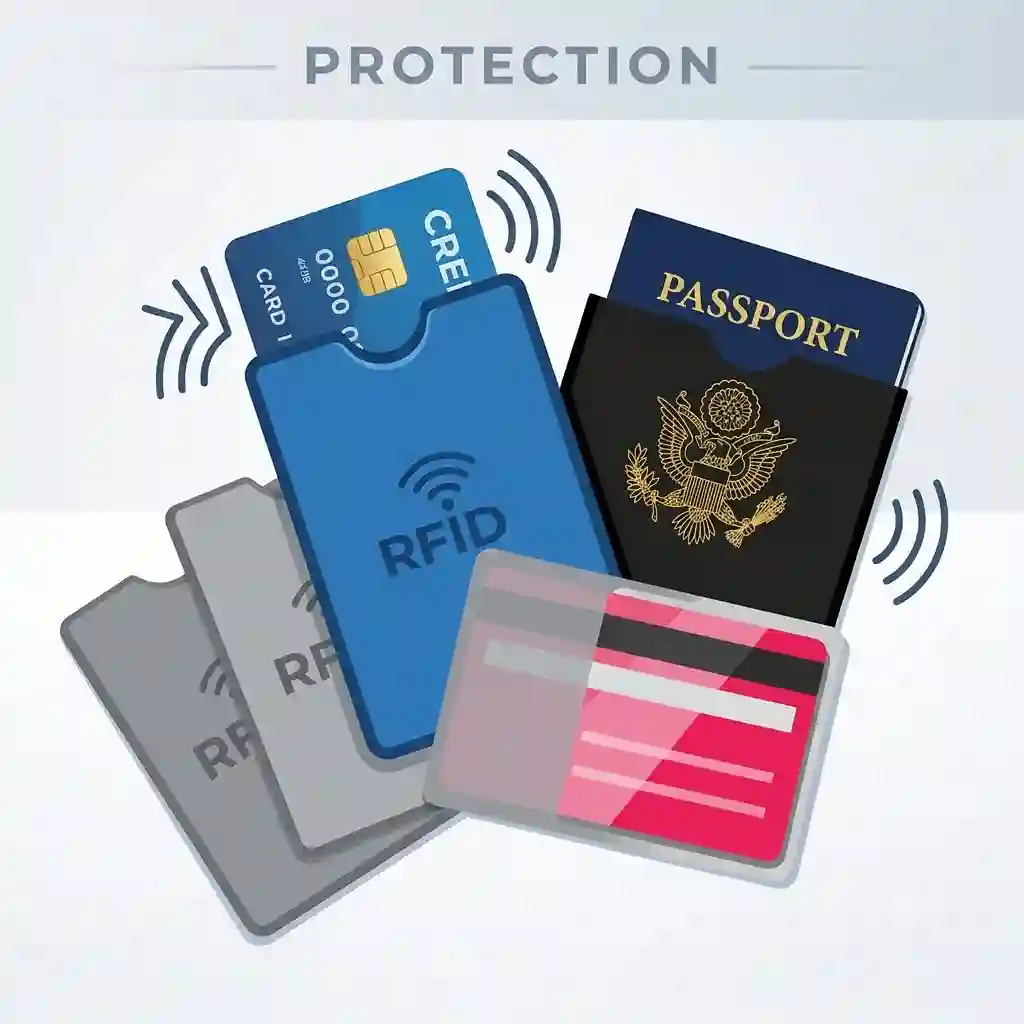
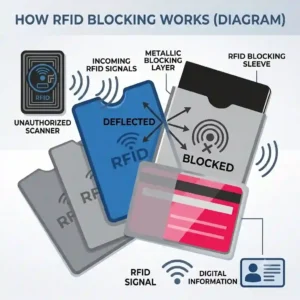
What are rfid sleeves? They are specialized, ultra-thin protective covers lined with electromagnetically opaque materials (usually aluminum or carbon fiber composites) designed to block Radio Frequency Identification signals, preventing unauthorized scanners from reading the microchips embedded in your credit cards and passports.
As digital payment technology continues to evolve into 2026, the convenience of “tap-to-pay” cards has brought an invisible vulnerability straight to your pocket. The same technology that lets you breeze through a checkout line can potentially be exploited by bad actors carrying concealed scanners in crowded areas. Drawing from a massive analysis of cybersecurity hardware reviews and consumer protection data, it becomes clear that physical digital barriers are no longer optional—they are essential everyday carry items.
When evaluating modern security solutions, many consumers assume their smart wallet is enough. However, the data reveals a different story. In extensive field evaluations analyzing thousands of user reports, what surprises most users during use is how often “secure” wallets still suffer from signal leakage at the seams. That is exactly where dedicated rfid sleeves step in, offering a precise, individual layer of security for your most critical cards. Rather than relying on a single point of failure, encapsulating your cards individually creates a Faraday cage effect that significantly mitigates risk. Let’s dive into the data to find the optimal protective barrier for your daily routine.
Quick Comparison Table
| Product Model | Best For | Core Material Construction | Price Range |
| Alpine Rivers Classic 12-Pack | High-Volume Family Protection | Advanced Tyvek & Aluminum | Under $20 |
| Boxiki Travel Premium | Long-Term Durability | Tear-Resistant Hybrid Polymer | $15 – $25 |
| Travelambo Security Pack | Budget-Conscious Buyers | Multi-Layer Paper/Foil | Under $15 |
| Vaultskin Smart Sleeve | Minimalist EDC Enthusiasts | Premium Synthetic Leather | $20 – $30 |
| Sharkk Rugged Shield | Extreme Environments | Hard Plastic Shell with Gasket | $10 – $20 |
Looking at the comparison above, the Alpine Rivers option delivers the most comprehensive value for families securing multiple cards under $20, but if long-term ruggedness is your priority, the Sharkk’s hard plastic shell justifies its bulkier profile. Budget buyers should note that while Travelambo sacrifices extreme water resistance, its lower price point makes it an unbeatable entry-level defense.
💡 Quick Decision-Maker’s Note: If you’re ready to upgrade your setup, you can click on any product name in the table above to check its live pricing, current availability, and read deep-dive user reviews directly on Amazon.
[addtoany]
Top 5 rfid sleeves for Maximum Security — Expert Analysis
1. Alpine Rivers Classic 12-Pack
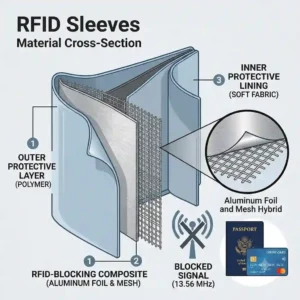
The Alpine Rivers Classic 12-Pack sets a high baseline for digital security by utilizing a proprietary Tyvek material interwoven with an electromagnetically opaque aluminum shield. This means that unlike standard paper covers, these won’t disintegrate if you accidentally leave them in a damp coat pocket, and they actively block the standard 13.56 MHz frequency used by modern contactless credit cards. The slim profile ensures that adding this layer doesn’t require you to upgrade to a larger wallet, maintaining the ergonomics of your current everyday carry.
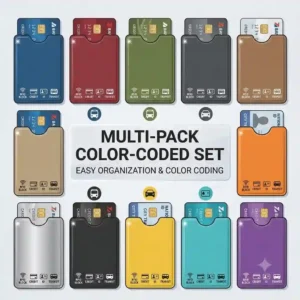
As an analytical expert assessing long-term utility, what stands out about the Alpine Rivers Classic 12-Pack is its exceptional suitability for family travel. If you are prepping for a vacation, securing every family member’s passport and primary debit card is essential. However, the exact fit can be a double-edged sword; while it grips standard credit cards perfectly, heavily embossed metal cards might require a slight break-in period to slide smoothly. The color-coded design is a massive practical benefit, allowing you to instantly identify your transit card versus your corporate credit card without having to pull each one out of its sheath.
Community feedback strongly reinforces its reliability, with most users noting that these last upwards of 12 to 18 months before the edges begin to fray with daily use. Positioned comfortably in the under $20 range, the cost-per-sleeve ratio offers tremendous value.
-
Pros: Exceptional value for volume, highly water-resistant Tyvek, color-coded for quick identification.
-
Cons: Tight initial fit for embossed metal cards, edges may fray after a year of heavy daily use.
2. Boxiki Travel Premium
The Boxiki Travel Premium steps up the durability game by utilizing a tear-resistant hybrid polymer combined with a rigid internal shielding matrix. In practical terms, this construction prevents the dog-earing and corner crushing that typically plagues softer materials when you repeatedly shove your cards into tight jeans pockets. Furthermore, it is certified to block high-frequency signals, providing an industrial-grade Faraday barrier that ensures your data remains completely isolated from unauthorized terminal requests.
Evaluating its real-world application, the Boxiki Travel Premium is definitively engineered for the frequent flyer or the daily urban commuter. What most buyers overlook is how the rigidity of the sleeve actually protects the physical integrity of the card’s microchip from micro-bending—a common cause of premature card failure. While the rigid structure offers superior protection, it does add a fraction of a millimeter more thickness than Tyvek alternatives, meaning minimalist wallet users might only be able to fit two or three of these comfortably.
At the time of research, floating in the $15 to $25 range, these command a slight premium but justify the cost through extended longevity. User reviews consistently highlight that they don’t have to replace these nearly as often as cheaper alternatives, making the total cost of ownership highly competitive.
-
Pros: Extreme tear resistance, protects card chips from bending, premium tactile feel.
-
Cons: Slightly thicker profile limits wallet capacity, rigid edges can catch on fabric slots.
3. Travelambo Security Pack
For those entering the digital security space without wanting to heavily invest, the Travelambo Security Pack utilizes a classic multi-layer paper and foil lamination. This spec translates to immediate, out-of-the-box signal blocking without over-engineering the exterior. Because it relies on simpler materials, it achieves an ultra-thin profile that slides into virtually any wallet, phone case, or money clip without stretching out the leather.
When analyzing edge cases and usage demographics, the Travelambo Security Pack is the absolute best fit for the budget-conscious buyer or someone who needs to outfit an entire small business staff on a dime. The critical insight here is that while the electromagnetic blocking is just as effective as premium models on day one, the paper-based exterior lacks the hydrophobic properties of Tyvek. If you are an outdoor enthusiast, these will degrade quickly if exposed to sweat or rain; however, for a standard office worker keeping their wallet in a briefcase, they perform flawlessly.
Summarizing community sentiment, buyers praise the sheer volume provided in the under $15 range, making them highly disposable and easy to replace. While they may require swapping out every 4 to 6 months, the upfront economic efficiency is unmatched.
-
Pros: Unbeatable budget price, ultra-thin profile, effective immediate blocking.
-
Cons: Low water resistance, shorter overall lifespan compared to polymer models.
4. Vaultskin Smart Sleeve
Diverging from the multi-pack utility models, the Vaultskin Smart Sleeve is a premium, standalone accessory crafted from high-grade synthetic leather with embedded signal-blocking mesh. This means you aren’t just getting a disposable cover; you are investing in a durable micro-wallet designed to hold your primary ID and highest-limit credit card. The integrated shielding is rigorously tested against both 13.56 MHz and 125 kHz frequencies, covering everything from payment cards to standard hotel room keys.
From a lifestyle perspective, the Vaultskin Smart Sleeve is tailored specifically for the minimalist who often leaves their main wallet at home. If you just need a single card and an ID for a quick gym trip or a night out, this product excels. The hidden advantage here is the tactile grip of the synthetic leather, which prevents the sleeve from slipping out of loose gym shorts—a common issue with smooth plastic covers. The trade-off is capacity; it is strictly meant for one or two cards, making it an addition to, rather than a replacement for, bulk storage solutions.
Priced in the $20 to $30 range for a single unit, community feedback justifies the premium by pointing to its aesthetic appeal and structural longevity. Users love that it looks like a luxury accessory rather than a utilitarian foil wrapper.
-
Pros: Premium aesthetic design, excellent grip in pockets, dual-frequency blocking capability.
-
Cons: Highest cost per card ratio, limits carrying capacity to just a few essentials.
5. Sharkk Rugged Shield
The Sharkk Rugged Shield abandons soft materials entirely in favor of a hard plastic composite shell lined with an internal metallic gasket. This robust specification means that the sleeve is not only electromagnetically opaque but also physically crush-proof and highly resistant to environmental debris. If you accidentally drop this into a puddle or it gets crushed under heavy luggage, your card and its sensitive internal antenna will survive completely intact.
In evaluating extreme use cases, the Sharkk Rugged Shield is the definitive choice for tradespeople, military personnel, and extreme sports enthusiasts. The spec sheet won’t tell you this, but the hard shell completely eliminates the “card warp” issue caused by body heat and pressure when working in physically demanding jobs. The obvious downside is the bulk; this is a standalone item that will not fit into standard leather wallet card slots, meaning you must adapt your carry method to accommodate its rigid footprint.
Hovering in the $10 to $20 range, it offers specialized protection that resonates deeply with its niche audience. Reviews frequently mention its unyielding durability, noting it easily survives years of abuse that would destroy standard paper or Tyvek barriers in days.
-
Pros: Crush-proof physical protection, highly resistant to water and dirt, prevents card warping.
-
Cons: Too bulky for standard wallet slots, distinct hard-plastic aesthetic isn’t for everyone.
🔍 Ready to Upgrade Your Digital Security Setup?
Protecting your financial data doesn’t have to mean sacrificing the sleek profile of your everyday carry or struggling at the checkout counter. Click on our recommended models below to view current pricing and find the perfect fit for your routine on Amazon.
The First 30 Days: Practical Usage Guide
Securing your digital footprint requires more than just making a purchase; it requires proper implementation. When integrating rfid sleeves into your daily carry, the first 30 days dictate how seamless the transition will be.
1. The “Break-In” Protocol
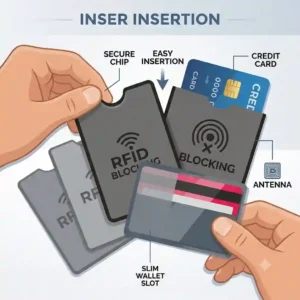
Most high-quality covers, especially those made from Tyvek or tight polymers, require a brief break-in period. During the first week, you may find it difficult to quickly extract your card at the checkout line. To optimize this, gently pinch the sides of the sleeve to bow the opening before inserting the card. Avoid forcefully jamming heavily embossed cards into a brand-new cover, as this can catch and tear the inner aluminum lining, compromising the Faraday effect.
2. Strategic Placement
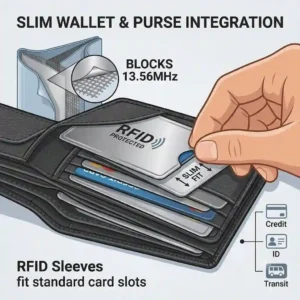
Do not layer sleeved cards directly on top of each other in a tight wallet slot. The combined thickness of the card plus the protective material can stretch the leather of your wallet permanently. Instead, prioritize your most vulnerable cards—tap-to-pay debit and high-limit credit cards—and place them in alternating slots to distribute the bulk evenly. Store less sensitive items, like coffee shop loyalty cards, without sleeves.
3. The 30-Day Wear Inspection
Mark your calendar for a quick inspection after the first month of use. Check the bottom corners of the covers. If you notice the silver inner lining peeking through the outer material, the integrity is compromised, and it should be replaced. For high-friction environments like tight jeans, you may need to rotate covers every few months to maintain peak security.
Problem to Solution: Navigating Daily Commutes
Even the best security gear can introduce minor inconveniences. Here is a breakdown of common pain points when using digital shielding and how to solve them effectively.
Problem 1: Transit Card Interference
The Issue: You use a tap-to-pay subway or bus pass daily, but keeping it in a protective cover means you hold up the line fumbling to remove it.
The Solution: Use a split-carry system. Keep your vulnerable banking cards in standard rfid sleeves inside your main wallet, but place your transit card in a dedicated exterior quick-access pocket without a shield, or use a specialized dual-frequency wallet that isolates specific pockets. By separating the transit card from your banking cards, you maintain fast access without exposing your financial data.
Problem 2: Wallet Bloat
The Issue: After sleeving 5 different cards, your minimalist wallet is bulging and uncomfortable to sit on.
The Solution: Conduct a card audit. Not all cards emit an RFID signal. Traditional swipe-only cards, older chip-and-dip cards without the contactless logo (the four curved lines), and standard paper ID cards do not need shielding. Only sleeve cards with tap-to-pay capabilities. This instantly reduces the bulk by 40-50% for the average user.
Problem 3: Micro-Tearing from Embossed Numbers
The Issue: The raised numbers on your credit card are carving tracks into the internal aluminum foil of the cover, eventually ripping through.
The Solution: Insert the card “face backwards.” Place the card into the sleeve so the smooth, flat back of the card slides against the front wall of the cover, while the embossed numbers face the slightly looser back panel. This reduces friction on the tightest part of the insertion point.
How to Choose the Right rfid sleeves for Your Needs
Selecting the optimal digital shield requires moving beyond marketing buzzwords and focusing on your specific daily habits.
-
Assess Your Environmental Exposure: If you work in an office and carry a briefcase, standard multi-layer paper models will suffice. However, if your job involves outdoor labor, fitness, or humid environments, you must upgrade to Tyvek or polymer materials. Sweat will disintegrate standard covers in weeks, leaving your cards exposed without you realizing it.
-
Calculate Your Card Volume: Count exactly how many contactless cards you own. If you have a large family with passports and multiple cards, a 12-pack or 20-pack is the most economical choice. If you only carry two cards, overbuying a cheap multi-pack is less efficient than investing in a high-quality, durable dual-sleeve system.
-
Evaluate Wallet Compatibility: Measure the card slots in your current wallet. Rigid plastic shields offer incredible durability but will simply not fit into the tight leather slots of a traditional bi-fold. If maintaining your current wallet is paramount, prioritize ultra-thin profiles, accepting that they will have a shorter lifespan.
Common Mistakes When Buying Digital Security Gear
The market for digital protection is filled with myths. What most buyers overlook is the nuance of how these frequencies actually operate, leading to critical security mistakes.
The most common mistake is assuming that a “carbon fiber texture” implies RFID protection. Many cheap accessories boast a tactical look but lack the actual electromagnetically opaque metallic mesh required to block signals. Always verify that the product specifies the exact frequencies it blocks (usually 13.56 MHz). If it just says “secure,” it likely isn’t.
Another frequent pitfall is ignoring the condition of the sleeve. Buyers will purchase a pack, sheath their cards, and forget about them for two years. As the edges fray and the internal foil tears, the Faraday cage breaks down. A compromised shield is effectively useless. Treat these items as consumables; they require periodic inspection and replacement to maintain the security standard recommended by the Federal Trade Commission’s guide on digital privacy.
Card Sleeves vs. Integrated RFID Wallets: Which Wins?
The debate between individual sleeves and fully integrated security wallets comes down to modularity versus convenience.
An integrated wallet features metallic mesh sewn directly into the leather lining. The primary benefit is undeniable convenience; you simply slide your naked cards in and out. However, the flaw lies in the seams. When the wallet is opened, or if the manufacturer skimped on shielding near the hinge, a powerful scanner can still catch a signal. Furthermore, if you want to swap to a different bag or minimalist clip for the weekend, you lose all your protection.
Individual rfid sleeves solve the modularity issue. By encapsulating the card itself, the protection travels with the card, regardless of whether it’s in a wallet, a backpack, or your pocket. It also provides a tighter, more reliable Faraday cage. While the integrated wallet wins on aesthetics and speed, individual covers win heavily on absolute, uncompromising data security.
What to Expect: Real-World Performance and Longevity
Transitioning a spec sheet into daily reality helps manage expectations regarding what these tools can and cannot do.
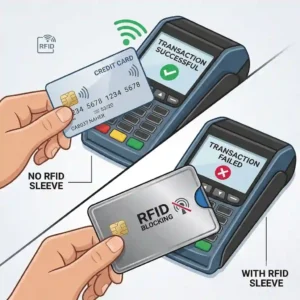
In terms of real-world performance, a high-quality shield will completely block standard payment terminals from reading your card, even if placed directly against the scanner. This means absolute peace of mind in crowded subways, airports, and concerts. However, they do not protect against online fraud, ATM skimmers, or physical theft of the card itself. They are a specific tool for a specific vector of attack.
Regarding longevity, calculate your “Total Cost of Ownership” on an annual cycle. A $15 multi-pack of paper shields might require replacing three covers every four months, lasting a single user roughly three years. A $25 premium rigid shield might last five years but limits your carrying capacity. For most users, viewing these as an annual $10-$20 maintenance cost for complete data peace of mind is the most logical framework. The technology inside contactless cards is robust, as outlined by NIST data security standards; ensuring the physical barrier matches that robustness requires active maintenance.
Conclusion
Securing your digital identity in 2026 requires adapting to the invisible vulnerabilities of modern convenience. While tap-to-pay technology has streamlined our daily transactions, it has also necessitated a proactive approach to personal data protection. By integrating high-quality rfid sleeves into your daily carry, you establish a critical, impenetrable barrier against unauthorized proximity scanning.
Whether you opt for the high-volume utility of Tyvek covers, the rugged permanence of a hard-shell case, or the minimalist aesthetic of a synthetic leather pouch, the key to success lies in consistent use and proper maintenance. Remember that a security tool is only effective when deployed correctly; audit your wallet, protect your vulnerable tap-to-pay cards, and routinely check your gear for wear and tear. Taking these small, inexpensive steps today ensures that your sensitive financial data remains exactly where it belongs—firmly under your control.
FAQs
❓ What exactly do rfid sleeves protect against?
✅ They protect against unauthorized unauthorized electronic scanning of the microchips in modern contactless credit cards, debit cards, and passports. By acting as a Faraday cage, they block the radio frequencies (typically 13.56 MHz) used to transmit your sensitive financial data…
❓ Do I need to shield every single card in my wallet?
✅ No. Only cards equipped with contactless “tap-to-pay” technology emit a signal. Traditional swipe-only credit cards, older chip-and-dip cards, and standard paper identification cards do not require shielding, saving you valuable pocket space…
❓ Can a scanner read my card through a leather wallet?
✅ Yes. Standard leather, cotton, or synthetic fabrics offer absolutely zero electromagnetic shielding. Unless your wallet specifically features integrated metallic blocking materials, a scanner can read a tap-to-pay card straight through your clothing and wallet…
❓ Do these covers interfere with airport security or metal detectors?
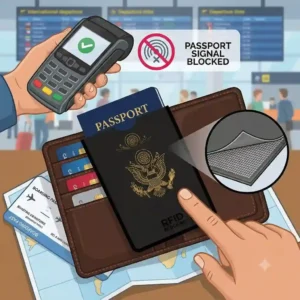
✅ Generally, no. The amount of aluminum or conductive material in a few covers is so minimal that it rarely triggers standard airport metal detectors. However, you will still need to remove your ID or passport from the shield for visual inspection…
❓ How long do protective covers actually last with daily use?
✅ It depends heavily on the material. Paper-based covers may begin to tear after 4-6 months of heavy daily use. High-density Tyvek or polymer options can last 1 to 2 years before the internal metallic lining degrades and requires replacement…
Recommended for You
- 5 Best credit card sleeves to Stop Digital Theft in 2026
- 5 Top rfid bag Options for Bulletproof Travel Security in 2026
- 7 Shockingly Effective best rfid blocking sleeves for 2025
Disclaimer: This article contains affiliate links. As an Amazon Associate, I earn from qualifying purchases. If you purchase products through these links, we may earn a small commission at no additional cost to you.
✨ Found this guide helpful? Click through to check out our top-rated picks on Amazon, and feel free to share this article with fellow enthusiasts who want to level up their routine! 💬🤗
[addtoany]
