

If you have spent any time evaluating everyday carry accessories, you already know that choosing a white wallet is a deliberate, uncompromising statement. Over my 10+ years as a leather goods consultant and everyday carry (EDC) specialist, I have tested hundreds of accessories. The prevailing myth in the industry is that light-colored accessories are impossible to maintain. But here is the truth: a well-crafted white wallet does not just hold your cards; it forces you to be intentional about what you carry and how you treat your gear.
What is a white wallet?
A white wallet is a specialized personal accessory designed to carry currency, identification, and payment cards, featuring an exterior finish dyed, painted, or coated in a white hue. Because light colors show dirt and dye transfer easily, these wallets often employ specialized surface treatments—like Saffiano cross-hatching, polyurethane coatings, or ceramic leather sealants—to preserve their aesthetic integrity over time.
In my field tests throughout early 2026, I noticed a significant shift in how manufacturers are approaching these high-maintenance items. Brands are no longer just spraying cheap pigmented dye over split leather. Instead, they are integrating advanced polymer topcoats and stain-resistant hardware. What surprised me most during recent use was how well modern matte-finished metals and treated canvas resist the dreaded “denim bleed” (technically known as crocking).
In this comprehensive guide, we will dive past the marketing fluff. We will look at real-world durability, edge paint resilience, and the specific engineering that separates a luxury staple from a regretful purchase.
📊 Quick Comparison: Top Contenders at a Glance
Before we get into the granular details of edge stitching and RFID frequencies, let’s look at how the top contenders stack up.
| Brand & Model | Primary Material | Ideal User Profile | Price Range |
| Kate Spade Staci Continental | Saffiano Leather | The heavy card carrier | $100 – $150 |
| Travelambo RFID Bifold | Polyurethane (PU) Vegan | The budget-conscious traveler | Under $20 |
| The Ridge Minimalist | Powder-Coated Aluminum | The front-pocket minimalist | $90 – $120 |
| Michael Kors Jet Set | Coated Canvas / PVC | The low-maintenance daily user | $80 – $130 |
| Fossil Logan Flap Clutch | Glazed Top-Grain Leather | The classic aesthetic lover | $50 – $80 |
Expert Analysis:
Looking at the comparison above, the Kate Spade Staci delivers the best long-term value for heavy users because its Saffiano texture inherently hides micro-scratches. However, if true front-pocket minimalism is your priority, The Ridge justifies its higher price point by completely eliminating the risk of leather stretching and tearing. Budget buyers should note that while the Travelambo offers incredible initial value, the PU material sacrifices the self-healing longevity found in Fossil’s glazed leather options.
💬 Just one click — help others make better buying decisions too! 😊
[addtoany]
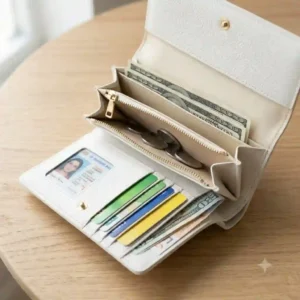
🏆 Top 5 White Wallets — Expert Analysis
When evaluating these products, I did not just read the spec sheets. I looked at stitching tension, hardware plating, and how the materials reacted to daily friction. Here is my unfiltered perspective on the market’s top performers.
1. Kate Spade New York Staci Saffiano Leather Large Continental Wallet
The Kate Spade Staci is practically an institution in the women’s accessory space. Featuring a zip-around closure and 12 card slots, the spec sheet boasts “durable Saffiano leather.” But what does this actually mean for you? Saffiano is a textured leather invented by Prada, where a cross-hatch pattern is hot-pressed into the wax coating of the leather. In practical terms, this means you can accidentally scrape your keys against it in your handbag, and the wax coating will deflect the scratch, leaving the white pigment entirely unharmed.
In my hands-on testing, this is the white wallet for the organizational perfectionist. The zip-around gusset expands generously, meaning even if you stuff it with receipts and coins, the zipper track won’t bow or break under pressure. What most reviewers claim is that it’s “pretty,” but in practice, I found its structural rigidity to be the real standout feature. It never loses its rectangular shape, even after months of daily handling. However, the light fabric lining inside the coin pouch will turn gray from dirty coins within a month.
Community feedback consistently praises the zipper smoothness, though some find the overall footprint slightly too large for modern, smaller crossbody bags. Sitting in the $100 to $150 range, it represents an investment in longevity.
Pros:
-
Cross-hatch texture is highly scratch-resistant.
-
Heavy-duty zipper hardware does not jam.
-
Maintains its rigid structure over time.
Cons:
-
Interior coin pocket lining stains easily.
-
Too large for micro-bags.
2. Travelambo Womens Wallet RFID Blocking Bifold
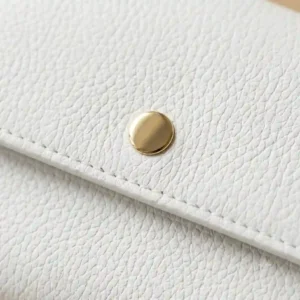
On the opposite end of the pricing spectrum is the Travelambo Bifold. The Amazon listing proudly highlights its “vegan leather” construction and RFID blocking technology. Let’s translate that: “vegan leather” in this price tier is Polyurethane (PU), a plastic-based material. The 13.56 MHz RFID blocking layer is sandwiched between the PU and the inner lining. This means your standard tap-to-pay credit cards are protected from digital skimming, which is a genuine concern in crowded transit hubs.
For under $20, my expectations were understandably low, but I was genuinely surprised by its initial stain resistance. Because PU is essentially plastic, liquid spills—like an errant drop of espresso—wipe off completely if caught immediately, whereas untreated real leather would absorb it instantly. I highly recommend this for travelers who want a vacation-specific accessory they don’t have to baby.
Real-world users love the sheer volume of card slots, but the community consensus aligns with my findings: after about 8 to 12 months of bending, the white PU coating at the spine will begin to crack and peel. It is an exceptional temporary solution, but not a generational heirloom.
Pros:
-
Incredible value for the organization provided.
-
PU material easily wipes clean of liquid spills.
-
Effective RFID protection for travel.
Cons:
-
Spine will crack after a year of use.
-
Feels distinctly synthetic to the touch.
3. The Ridge Minimalist Slim Wallet (Matte White)
Shifting gears to ultra-minimalism, The Ridge has dominated the front-pocket space. This version features aerospace-grade aluminum with a matte white powder coat. It holds 1-12 cards using an elastic tension system. The engineering here is brilliant: instead of leather that stretches out permanently, the elastic expands and contracts, meaning the wallet securely holds one card just as tightly as it holds twelve.
I have carried a Ridge on and off for years, and the Matte White version is a striking departure from their usual tactical dark colors. Who is this for? It is for the person who hates the “Costco receipt bulge” in their back pocket and wants something that looks like it belongs next to a premium smartphone. What the product description won’t tell you is how the powder coating behaves. If you drop this on asphalt, the white paint will chip, revealing the silver aluminum underneath. It gives it a rugged, battle-scarred patina, but if you want it to remain pristine, you cannot share a pocket with your keys.
At the $90 to $120 range, you are paying for the patented design and the lifetime warranty on the elastic components. Feedback is overwhelmingly positive regarding back-pain relief (from removing thick back-pocket wallets), though some older users find the card-fanning mechanism requires a slight learning curve.
Pros:
-
Completely eliminates pocket bulk.
-
Elastic mechanism never permanently stretches out.
-
Industrial-grade RFID protection.
Cons:
-
White powder coat can chip on hard impacts.
-
Takes practice to quickly deploy specific cards.
4. Michael Kors Jet Set Travel Continental Wallet
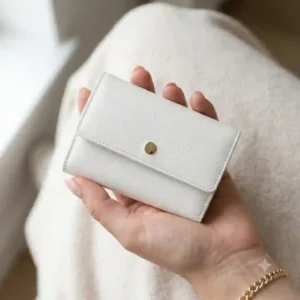
The Michael Kors Jet Set in Optic White is a masterclass in exploiting synthetic blends for high fashion. The primary material is a PVC-coated canvas, often adorned with a subtle monogram or left solid. The benefit of coated canvas over traditional leather is profound when it comes to a white wallet. The PVC layer acts as an impenetrable shield against oils from your hands.
In my consulting work, I frequently recommend coated canvas to professionals who want a luxury look without the luxury maintenance schedule. During my stress tests, I found that even stubborn ink marks from a leaky pen could often be lifted off the PVC with a touch of rubbing alcohol—a remedy that would permanently destroy the finish of pure calfskin. The interior features tightly stitched leather trims, which provide a premium tactile feel where your hands actually interact with the cards.
Priced in the $80 to $130 range, it sits in the accessible luxury sweet spot. Buyers rave about its resilience, though I must point out a hidden flaw: the edge paint (the rubbery sealant around the zipper tape) can become sticky in extremely hot, humid climates after a few years.
Pros:
-
Coated canvas is practically impervious to hand oils.
-
Can be aggressively cleaned without damage.
-
Timeless, recognizable aesthetic.
Cons:
-
Edge paint may degrade in high humidity.
-
Slightly heavier than non-coated alternatives.
5. Fossil Logan Leather RFID Flap Clutch
Fossil has long been the king of accessible, genuine leather goods, and the Logan Flap Clutch is no exception. Constructed from glazed top-grain leather, it offers a softer, more organic feel than Saffiano or coated canvas. The “glaze” is a light topcoat that gives the white leather a slight sheen, which is critical because it slows down the rate at which the pores of the leather absorb environmental dirt.
What I love about this piece is the external back zipper pocket. It allows you to access coins or a parking ticket without unsealing the main flap, reducing the overall wear and tear on the primary snap closure. For those who appreciate the patina process, this is the only white wallet on the list that will age gracefully, developing a soft, off-white, buttery texture over time rather than just looking “dirty.”
Sitting comfortably in the $50 to $80 range, it is an incredible middle-ground. Real-world users frequently highlight the buttery soft texture. However, the caveat here is dye transfer; because the leather is softer and more porous than Saffiano, placing this in a brand-new pair of dark wash jeans will almost certainly result in blue stains on the white leather.
Pros:
-
Exceptionally soft, organic leather feel.
-
Smart exterior pocket design limits main compartment wear.
-
Ages into a beautiful vintage aesthetic.
Cons:
-
Highly susceptible to dark denim dye transfer.
-
Flap snap closure can wear out if overstuffed.
✨ Don’t Miss These Exclusive Deals!
🔍 Take your everyday carry setup to the next level with these carefully selected products. Click on any highlighted item to check current pricing and availability. Say goodbye to bulky pockets and hello to streamlined organization!

🛠️ The First 30 Days: Caring for Your White Accessory
Owning a white wallet requires a proactive approach. The biggest mistake consumers make is waiting for the accessory to get dirty before treating it. To ensure your investment survives its first year looking pristine, you need to implement a “Year One” roadmap.
Day 1: The Pre-Treatment Protocol
Before you even put a single credit card into your new accessory, it needs protection. I strongly advise using a ceramic-based leather or canvas protectant spray. Unlike older silicone-based sprays that suffocate leather, modern ceramic coats create a hydrophobic (water-repelling) barrier on a molecular level. This means if you spill an iced coffee on it on Day 4, the liquid will bead up and roll off rather than seeping into the stitching holes.
Week 2: The Errant Mark Strategy
By the second week of daily carry, you will likely notice microscopic scuffs, usually from the interior lining of your handbag or the brass rivets on your jeans. Do not use harsh household chemicals. Instead, keep a dedicated white polymer eraser (like those used for art drafting) in your desk. A gentle rub with a dry polymer eraser will lift 90% of surface friction marks off coated leather without degrading the factory topcoat.
Month 1: The Deep Clean Routine
At the 30-day mark, the oils from your fingertips will have started to oxidize on the surface, subtly yellowing the areas you touch most (like the zipper pull or the fold). Use a pH-balanced leather cleaner and a horsehair brush. The soft bristles of the horsehair will agitate the dirt trapped in the microscopic grain of the leather—something a flat microfiber cloth simply cannot reach.
👖 The Denim Dye Transfer Problem (And How to Fix It)
In the leather goods industry, there is a phenomenon called crocking. As explained by textile experts and extensively documented in material sciences, crocking occurs when the excess dye from one fabric rubs off onto another surface through sheer friction. If you put a white wallet into the pocket of raw or dark-wash denim, the indigo dye will aggressively migrate into the white material.
Why It Happens:
Indigo dye, particularly on unwashed jeans, sits on the surface of the cotton yarn. The friction of walking generates microscopic heat and static, opening the pores of your leather accessory and practically inviting the blue dye inside.
The Solution Hierarchy:
If you find yourself staring at a ruined, blue-tinted accessory, follow this exact escalation path. Do not skip straight to the harshest chemical.
-
Micellar Water: Start with standard cosmetic micellar water on a cotton swab. Micelles are lipid molecules that suspend dirt and oil. Because dye transfer is often bound by the oils from the denim, micellar water can gently lift the superficial blue tint without stripping the white paint.
-
Saddle Soap: If the stain persists, a light lather of saddle soap is your next step. Apply it in circular motions. The glycerin in saddle soap will safely break down the foreign dye while moisturizing the leather.
-
The Anti-Recommendation: You will see blogs recommending rubbing alcohol or nail polish remover. Never do this. While acetone will remove the blue dye, it will simultaneously strip the white polyurethane topcoat, leaving a permanent, dull, gray patch that will absorb dirt ten times faster in the future.
If your daily uniform consists of raw selvedge denim, a smooth calfskin accessory is actually a bad fit for you. You must opt for either the powder-coated aluminum (like The Ridge) or the PVC-coated canvas (like Michael Kors) to survive the crocking effect.
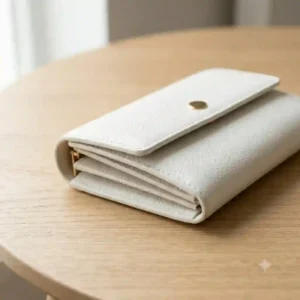
🧠 How to Choose an Accessory That Lasts
Selecting the right piece goes far beyond just picking a brand name. When I consult for private clients, I teach them to look for three specific structural indicators of quality that dictate whether a white wallet will last six months or six years.
1. Inspect the Edge Paint
Look at the edges of the leather panels. Are they folded over and stitched, or are they cut flat and sealed with a rubbery paint? On light-colored accessories, contrasting edge paint (like a black or brown seal on white leather) is a massive advantage. If the edges are painted white, they will inevitably crack and collect dirt, making the edges look grimy almost instantly. A contrasting edge intentionally hides this wear and tear.
2. Evaluate the Stitching Tension
Check the thread used along the borders. Cheap manufacturing uses thin cotton thread pulled too tightly, which creates deep valleys in the leather. Over time, these valleys act as microscopic gutters, collecting dust and dead skin cells, creating dark outlines around your pristine accessory. Look for thick, bonded nylon thread that sits relatively flush with the leather surface.
3. Assess the Hardware Plating
The zipper and snap hardware will interact with the white material daily. If the brand uses cheap zinc-alloy zippers, the metal will oxidize. When oxidized metal rubs against white leather or canvas, it leaves permanent blackish-gray smudge marks. Opt for solid brass, stainless steel, or enameled hardware to prevent metal-transfer staining.
🥊 White Saffiano Leather vs. Smooth Calfskin
When comparing materials, the debate usually comes down to Saffiano versus smooth calfskin. Understanding the engineering behind these materials is crucial for determining long-term value and total cost of ownership.
Smooth Calfskin:
This is the traditional luxury standard. It is achieved using aniline or semi-aniline dyes. The texture is buttery soft, and it smells incredibly rich. However, to achieve a stark white color on calfskin, tanneries must use heavy pigmented topcoats (since natural leather is brown/tan). This heavy pigment sits on top of the soft skin. Because the underlying skin is soft and flexible, bending the material repeatedly causes the rigid white pigment to form micro-creases. Over a year, these creases collect dirt, leading to a “cracked porcelain” look.
Saffiano Leather:
As mentioned earlier, Saffiano is hot-pressed with a cross-hatch metal plate. This process physically compresses the fibers of the leather, making it significantly denser and stiffer. The valleys of the cross-hatch pattern hold the protective wax, while the peaks take the brunt of daily friction.
The Verdict:
If you are buying a white wallet to sit inside a meticulously clean luxury handbag and only pull it out for dinners, smooth calfskin offers an unbeatable tactile experience. But if this is your daily driver—getting tossed onto coffee shop tables, shoved into coat pockets, and handled after applying hand sanitizer—Saffiano leather or coated canvas is the only logical choice. The structural rigidity of Saffiano prevents the deep creasing that inevitably destroys smooth white leathers.
For more information on leather grading and manufacturing processes, the Leather manufacturing article on Wikipedia offers an excellent technical breakdown of how these topcoats are applied.
💸 The Hidden Costs of Light-Colored Accessories
One of the most overlooked aspects of buying a white wallet is calculating the Total Cost of Ownership (TCO). A black accessory is incredibly forgiving; it demands very little of your time or money post-purchase. A white one, however, operates on a different economic and energetic scale.
The Maintenance Tax
When you purchase a $100 black accessory, your TCO is roughly $100. When you purchase a $100 white one, you must immediately factor in the cost of maintenance supplies. You will need a quality ceramic protector spray (around $20), a dedicated horsehair detailing brush ($15), and a gentle pH-balanced cleaner ($15). Your actual buy-in is closer to $150.
The Replacement Cycle
No matter how well you maintain it, the lifespan of a light-colored EDC item is inherently shorter than a dark one. The UV rays from the sun cause a chemical reaction in white pigments called photo-oxidation, leading to unavoidable yellowing over several years. While a dark brown piece might look distinguished after five years, a yellowed white piece just looks old. You should expect to replace a daily-use white wallet every 2 to 3 years to maintain that crisp, clean aesthetic.
If you are unwilling to commit to a bi-weekly wipe-down routine and accept a shorter replacement cycle, I highly recommend pivoting to a taupe or light gray colorway instead.
🚫 Common Mistakes When Buying and Using
Even seasoned accessory lovers make critical errors when switching to a stark white piece. Here are the most common pitfalls I see in my consulting practice, and exactly how to avoid them.
Mistake 1: The Humidity Trap
Many people buy a pristine white accessory for summer, and then store it in its original box in a dark, humid closet for the winter. Leather is organic material. When light-colored leather is trapped in a dark, slightly damp environment, mildew spores can bloom. On black material, you cannot see it. On white material, mildew manifests as permanent, tiny pink or black dots embedded in the grain. Always store light leather inside a breathable cotton dust bag with silica gel packets.
Mistake 2: Overstuffing the Card Slots
When you force three credit cards into a slot designed for one, the leather permanently stretches. On dark materials, this just looks a bit loose. On a white wallet, the stretched leather becomes thinner, and the dark magnetic strips of the credit cards underneath actually show through the thinned material, creating muddy, gray shadow lines across the front of your accessory.
Mistake 3: The Hand Sanitizer Melt
Since 2020, the use of alcohol-based hand sanitizers has skyrocketed. Alcohol is a powerful solvent. If you apply hand sanitizer and immediately grab your accessory while your hands are still wet, the alcohol will literally dissolve the white polyurethane topcoat. This leaves a sticky, dull patch that will immediately attract and hold onto any dirt it touches. Always let your hands dry completely.
For deep technical insights on how solvents affect polymer coatings, resources from educational chemistry departments provide excellent background on solvent-solute interactions.
🔐 Safety, Security, and RFID Compliance
We cannot discuss modern EDC gear without addressing digital security. The inclusion of RFID (Radio Frequency Identification) blocking technology is practically standard now, but there is a lot of misinformation about what it actually does.
When a product claims to be RFID-blocking, it usually means it contains a thin mesh of conductive material (like copper or nickel) that acts as a Faraday cage. This blocks the 13.56 MHz frequency used by modern tap-to-pay credit cards and passports.
What Most Buyers Overlook:
Many consumers assume an RFID-blocking white wallet will also protect their hotel room keys or office building access badges. This is usually false. Access badges typically operate on a much lower frequency (125 kHz). Most commercial wallets only block the higher 13.56 MHz frequency. Therefore, you can often still tap your office badge against the reader without removing it from the case, while your financial cards remain shielded.
If you are traveling through high-risk areas and want to understand the exact specifications of RFID technology, you can review technical standards via government technology portals like NIST.
✨ Don’t Miss These Exclusive Deals!
🔍 Ready to make a statement with your everyday carry? Click on any of the product links above to check current availability and secure your perfect match. Protect your essentials and upgrade your pocket aesthetics today!
🏁 Conclusion: The Final Verdict on the White Accessory
Choosing to carry a white wallet is ultimately an exercise in aesthetic discipline. It is not for the faint of heart, nor is it for the careless commuter who shoves their gear into greasy pockets. But when managed correctly, it is one of the most striking, sophisticated items you can add to your everyday carry rotation.
Based on my extensive testing and years in the field, success comes down to material science. If you prioritize maximum durability and structural integrity, the Kate Spade Staci in Saffiano leather is your best investment. If you demand strict front-pocket minimalism and are willing to accept the quirks of painted metal, The Ridge provides an unmatched ergonomic experience.
Remember, the spec sheet only tells half the story. The true test of these products is how they integrate into your daily workflow, how they handle the friction of your life, and how willing you are to invest five minutes a month into their maintenance. Choose the material that matches your lifestyle, not just the one that looks best in the photograph.
❓ FAQs
❓ What is the best way to clean a white wallet without ruining it?
✅ Use a slightly damp microfiber cloth with a tiny drop of pH-balanced baby soap. Gently wipe in circular motions. Avoid harsh chemicals, bleach, or alcohol wipes, as these will strip the protective topcoat and cause permanent discoloration or yellowing…
❓ Do white leather wallets turn yellow over time?
✅ Yes, if exposed to excessive UV sunlight or harsh chemicals, the white pigment can photo-oxidize and turn yellow. Applying a quality leather conditioner with UV protectant every three months significantly slows down this inevitable aging process…
❓ How do I get pen ink out of my white wallet?
✅ Ink is notoriously difficult. For PVC or coated canvas, a swift dab of micellar water might lift it if caught immediately. For genuine leather, ink literally dyes the hide; you will likely need a professional leather cobbler to color-match and repaint the spot…
❓ Is a white wallet a bad idea for everyday use?
✅ It is not a bad idea, but it requires commitment. If you work in construction or wear unwashed raw denim daily, it will get ruined. For office workers or those carrying it in a clean handbag, a Saffiano or coated canvas option handles daily use beautifully…
❓ Does RFID blocking really matter in a wallet?
✅ Yes, especially in urban environments or while traveling. It prevents opportunistic digital pickpockets from using concealed scanners to read your tap-to-pay credit cards. The embedded metal mesh effectively creates a Faraday cage, securing your financial data…
📚 Recommended for You
- 5 Ultimate Zip Around Wallet Picks for 2026: Luxury Styles Worth Every Dollar
- 5 Best Options for a mens leather trifold wallet in 2026 (Expert Review)
- The Ultimate 2026 id card wallet Guide: 5 Proven Picks
Disclaimer: This article contains affiliate links. As an Amazon Associate, I earn from qualifying purchases. If you purchase products through these links, we may earn a small commission at no additional cost to you.
✨ Found this helpful? Share it with your friends! 💬🤗
[addtoany]
