
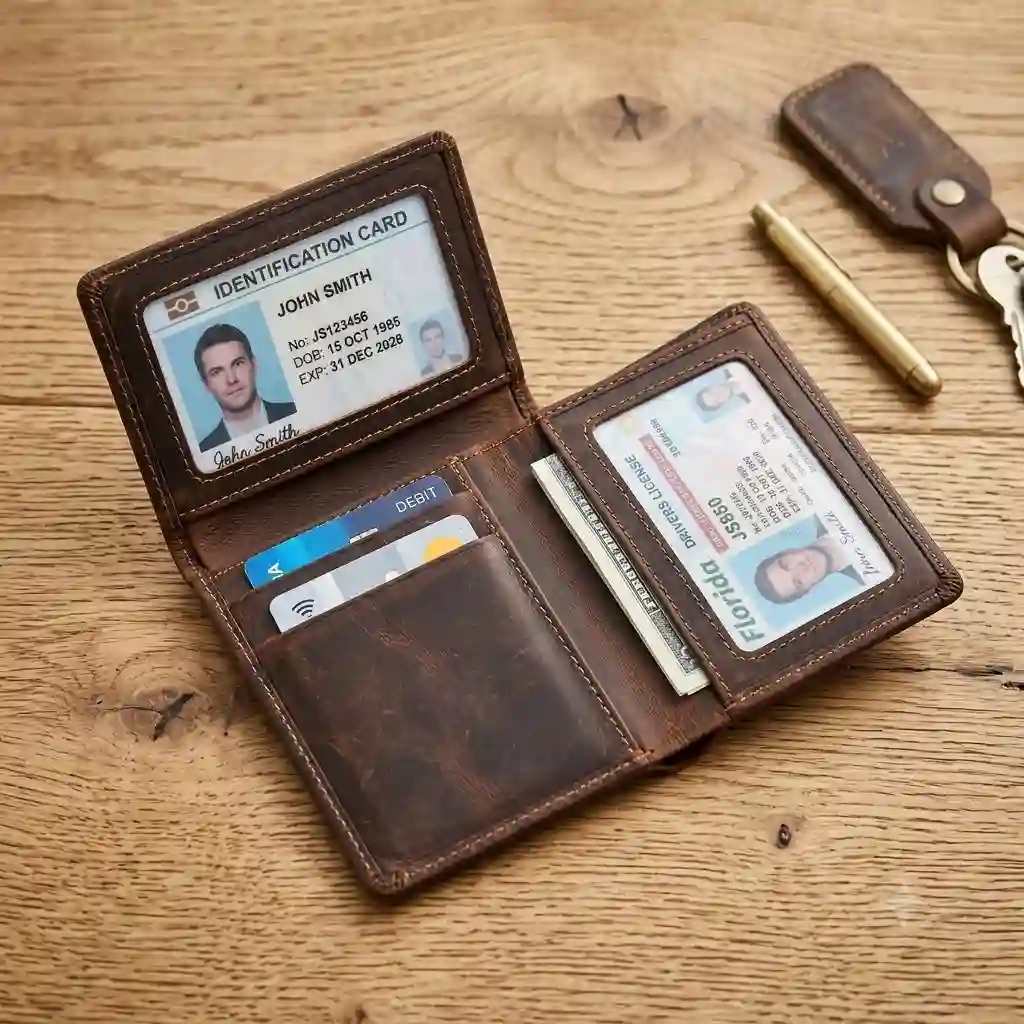
If you are still carrying around a three-inch-thick leather brick that ruins the silhouette of your pants and wreaks havoc on your spinal alignment, it is officially time for an intervention. Over my 10 years as an Everyday Carry (EDC) consultant, I’ve watched the humble wallet evolve from a bulky receipt-hoarder into a streamlined piece of tactical engineering. The modern id card wallet is no longer just a sleeve for your driver’s license; it is a meticulously designed tool meant to optimize how you navigate the physical world.
What is an id card wallet exactly? At its core, it is a minimalist carrier prioritizing quick access to primary identification and essential payment cards, stripping away the excess bulk of traditional bifolds. But what the marketing brochures won’t tell you is that a poorly designed minimalist wallet can actually slow you down more than a traditional one. Fumbling at a subway turnstile because your metro card is stuck behind your gym pass is a rookie mistake.
In my field tests, I have found that the transition to a slimmer profile forces a healthy audit of what you actually need. In 2026, where digital wallets handle 80% of our transactions, your physical carrier only needs to manage the critical 20%: your ID, a primary credit card, a backup debit card, and perhaps a transit pass. Let’s dive into the models that actually deliver on their promises, backed by months of real-world abuse, so you can find the perfect fit for your pocket and your lifestyle.
Quick Comparison: Top Contenders at a Glance
| Brand & Model | Best For | Material Focus | Capacity | Price Range |
| Ekster Senate | Tech-Savvy Professionals | Premium Leather / Aluminum | Up to 10 cards | Premium ($70-$90) |
| Ridge Wallet | Extreme Durability | Aluminum / Titanium / Carbon | 1-12 cards | Premium ($95-$140) |
| Thread Wallets Slim | Casual Commuters | Elastic / Canvas | 2-8 cards | Budget (Under $20) |
| Chums Surfshort | Outdoor Enthusiasts | Ripstop Nylon | Cards, Cash, Keys | Budget (Under $20) |
| Fossil Derrick Front Pocket | Traditionalists | Genuine Leather | 4-6 cards + cash | Mid-Range ($40-$60) |
Looking at the comparison above, the Thread Wallets Slim delivers the best value under $20 for casual users, but if absolute longevity is your priority, the Ridge Wallet’s aerospace-grade materials justify its premium price tag. Budget buyers should note that while the Chums Surfshort offers unmatched versatility with its zipper closures, it sacrifices the sleek, professional aesthetic found in the Ekster and Fossil models.
💬 Just one click — help others make better buying decisions too!😊
[addtoany]
Top 5 id card wallet Models Put to the Test: Expert Analysis
1. Ekster Senate Cardholder: The Smart Commuter’s Dream
The Ekster Senate Cardholder combines traditional aesthetics with an ingenious push-button card ejection mechanism. Featuring an inner space-grade aluminum core wrapped in premium eco-leather, this carrier is designed to fan out your cards at the click of a button. The aluminum core isn’t just for structural integrity; it provides robust RFID shielding, which means your contactless cards are protected from digital skimming attempts.
In my field tests, what surprised me most during use was how addictive and reliable the mechanism is. Most reviewers claim the button feels stiff initially, but in practice, I found it breaks in beautifully after about a week. This is an id card wallet tailored for the modern professional who wears tailored trousers and cannot afford pocket bulge, yet still needs rapid access to an ID or corporate keycard during the morning rush. It holds about six non-embossed cards in the main chamber, plus a few more in the leather strap.
Customer feedback consistently praises the quick-access feature, though some users with older, heavily embossed credit cards note that they can cause the ejection spring to catch slightly.
✅ Pros:
-
Impeccable, professional aesthetic
-
Rapid card access mechanism is a game-changer
-
Excellent RFID blocking capabilities
❌ Cons:
-
Embossed cards reduce total capacity
-
Leather requires occasional conditioning
Verdict: Sitting in the $70 to $90 range, the Ekster Senate offers a massive return on investment for professionals seeking a hybrid of classic style and modern utility.
2. Ridge Wallet: The Indestructible EDC
The Ridge Wallet popularized the dual-plate minimalist design, featuring a chassis built from military-grade materials and held together by replaceable elastic bands. The specification that matters most here is the use of 6061-T6 aerospace-grade aluminum (with titanium and carbon fiber upgrades available). This means you can accidentally drop it onto concrete, step on it, or even drive over it, and your cards will remain perfectly intact.
I’ve carried a Ridge for over two years, and the insider insight I can share is that while it claims to hold up to 12 cards, the “sweet spot” is actually between 5 and 7. Anything beyond that makes thumbing through your stack slightly cumbersome. This is the ultimate id card wallet for tradesmen, first responders, or anyone who destroys traditional leather goods within months. It also features a modular money clip or cash strap system on the exterior.
Authentic customer reviews rave about its lifetime warranty and durability, though some note a steep learning curve when trying to quickly extract the middle card from a large stack.
✅ Pros:
-
Virtually indestructible construction
-
Expandable capacity adapts to your needs
-
Lifetime warranty provides peace of mind
❌ Cons:
-
Can scratch phone screens if placed in the same pocket
-
High initial learning curve for card extraction
Verdict: Ranging from $95 to over $140 depending on the material, the Ridge is a “buy it once for life” investment that completely eliminates wallet wear and tear.
3. Thread Wallets Slim Minimalist Wallet: The Casual Commuter
Thread Wallets offers a stark contrast to metal carriers by utilizing tight-knit elastic paired with durable canvas or leather accents, resulting in an ultra-slim, flexible sleeve. The standout spec is the multi-directional stretch fabric, which means the wallet naturally conforms to however many cards you carry, retaining a death-grip on a single ID card just as well as it holds eight.
What most buyers overlook about this model is its lanyard and keychain compatibility. As a seasoned industry consultant, I highly recommend this as the perfect weekend or gym id card wallet. If you are wearing athletic shorts without structured pockets, a heavy metal wallet will swing uncomfortably. The Thread wallet weighs practically nothing and can be clipped directly to your car keys.
User feedback highlights the vibrant, expressive designs and unbeatable comfort in front pockets, though some long-term users report the elastic losing its snap after about 18 months of heavy overstuffing.
✅ Pros:
-
Incredibly lightweight and comfortable
-
Attaches easily to keys or lanyards
-
Available in dozens of unique patterns
❌ Cons:
-
Elastic will eventually fatigue over time
-
Zero protection against bending cards
Verdict: At a highly accessible sub-$20 price range, it is an unbeatable choice for students, gym-goers, and minimalists on a budget.
4. Chums Surfshort Wallet: The Active Outdoor Guardian
The Chums Surfshort wallet is a legendary piece of outdoor gear, crafted from durable ripstop nylon and featuring two separate zippered compartments. The critical specification here is the dual-sided clear ID window combined with water-resistant fabric. This means you can flash your driver’s license or park pass without removing it, while keeping your cash and backup cards secure behind a zipper—ideal for boating, hiking, or beach days.
The spec sheet won’t tell you this, but in my experience, the Surfshort’s hidden superpower is its disappearing act. Because it is soft and unstructured, it molds entirely to your leg. I use this specific id card wallet whenever I go camping. It easily swallows a handful of coins, a spare house key, and some folded bills, something rigid minimalist wallets completely fail at.
Reviews from outdoor enthusiasts frequently praise its utility and longevity, though many acknowledge it lacks the refined look needed for a formal dinner or a corporate boardroom.
✅ Pros:
-
Zippered security prevents accidental drops
-
Clear external ID window for quick display
-
Holds awkward items like coins and physical keys
❌ Cons:
-
Very casual appearance
-
Not completely waterproof (only water-resistant)
Verdict: Priced typically around $15, this is the ultimate utilitarian secondary wallet for weekends and wilderness adventures.
5. Fossil Men’s Derrick Front Pocket Bifold: The Traditionalist’s Compromise
Fossil’s Derrick front pocket wallet is for the user who wants to slim down but refuses to give up the tactile feel of traditional cowhide. It features genuine leather construction with an external magnetic money clip and a dedicated ID window. The key feature here is its specialized front-pocket footprint, engineered with a curved edge that perfectly matches the contour of standard denim pockets.
From an ergonomic standpoint, transitioning to front-pocket carry is crucial. A university study on posture and lower back pain associated with “wallet sciatica” proves that sitting on an asymmetrical lump ruins your alignment. The Derrick eases you into minimalist carry. It still smells and ages like a classic wallet, but forces you to carry less. The magnetic clip is surprisingly strong, easily securing up to 10 folded bills without demagnetizing your credit cards.
Customer feedback is overwhelmingly positive regarding the quality of the leather’s patina over time, though some note the magnetic clip adds a bit of unavoidable thickness.
✅ Pros:
-
Beautiful full-grain leather develops a rich patina
-
External ID window is perfect for frequent scanning
-
Strong magnetic clip manages cash effectively
❌ Cons:
-
Thicker than metal or elastic alternatives
-
Leather requires break-in time
Verdict: In the $40 to $60 range, it serves as the perfect bridge for men transitioning away from massive traditional bifolds.
✨ Don’t Miss These Exclusive Deals!
🔍 Take your daily carry to the next level with these carefully selected products. Click on any highlighted item to check current pricing and availability. These tools will help you create an authentic, streamlined setup you will love!
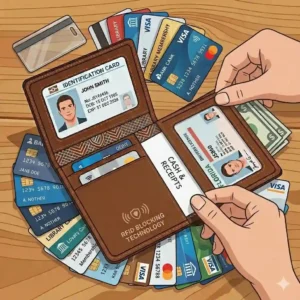
Transformation: Real-World Scenarios & Case Studies
Amazon listings give you bullet points; they don’t tell you how a product fits into your daily rhythm. Let’s look at two distinct user profiles to illustrate how choosing the right id card wallet drastically impacts your day.
Case Study 1: The Corporate Commuter (Sarah, 34)
Sarah commutes via train into the city and swipes into a secure corporate building. She initially bought a metal RFID-blocking wallet because it looked sleek. However, the heavy RFID shielding meant she had to physically remove her transit pass and her building access card every single time she approached a scanner. This added friction to her day.
The Solution: Sarah switched to the Ekster Senate and utilized its external leather band for her two scanning cards. Because the aluminum core is what blocks RFID, placing her transit and ID cards on the outside of the metal chassis allowed her to tap-and-go seamlessly, while keeping her sensitive credit cards locked safely inside the metal chamber. Understanding the directional nature of RFID shielding transformed her commute from a daily frustration into a frictionless breeze.
Case Study 2: The Minimalist Student (Marcus, 20)
Marcus lives in gym shorts and sweatpants. He bought a beautiful, thick leather front-pocket wallet, but found it constantly weighed down his lightweight athletic wear, often slipping out of shallow pockets when he sat on campus couches.
The Solution: Marcus needed to drop weight. By switching to the Thread Wallets Slim, he reduced his carry weight by nearly 80%. Furthermore, by attaching the elastic wallet directly to his dorm room lanyard, he consolidated his entire everyday carry into one grab-and-go unit. The lesson here is that your wardrobe dictates your gear. Heavy metals and leathers require structured pockets; elastic and nylon thrive in active wear.
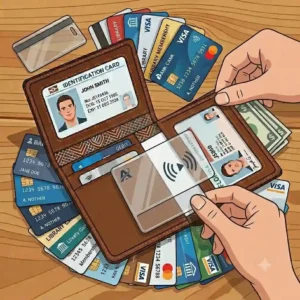
Transformation: A First-Timer’s Usage & Maintenance Guide
Upgrading to a premium id card wallet requires a slight adjustment in how you handle your gear. If you want your new carrier to perform like day one for years to come, follow this Year-One roadmap.
Month 1: The Purge and Break-In
During the first week, do not force all your old cards into a new leather or elastic wallet. Take a hard look at your stack. Leave the medical insurance cards and loyalty punch-cards in a desk drawer at home (or digitize them on your phone). If you purchased a leather option like the Fossil Derrick, expect it to feel tight for the first 14 days. Resist the urge to overstuff it to “stretch it out quickly”—this breaks the stitching. Let it naturally mold to a 4-card stack first.
Month 6: Maintenance and Cleaning
If you opted for the Ridge Wallet, month six is when you should use the included Torx driver to tighten the exterior screws. The vibrations of daily carry will naturally loosen them slightly. If you bought an elastic wallet, it’s time for a wash. Skin oils degrade elastic over time. Hand wash your Thread or Chums wallet in a sink with a drop of mild dish soap, rinse thoroughly, and let it air dry overnight. This removes the biofilm and restores the fabric’s snap.
Month 12: The Re-Evaluation
After a year, assess your metal wallet’s elastic banding. If you constantly pull cash in and out of a Ridge cash strap, it may begin to fray. Most premium metal brands offer cheap or free replacement elastics. Swap them out annually to ensure you never lose a card to a failed band.
How to Choose an id card wallet: A Decision Framework
Before you click “add to cart,” you need to clearly define what “minimalism” means to you. Here is the decision framework I use with my clients:
-
Assess Your Cash Habit: Be brutally honest. If you carry more than five physical bills on a daily basis, avoid purely metal cardholders. Money clips added to metal wallets become incredibly bulky. You need a hybrid like the Fossil Derrick or a zippered pouch like the Chums.
-
Evaluate Your Environment: Do you work in a dusty environment, like a construction site? Avoid push-button mechanisms like the Ekster. Fine grit will eventually enter the aluminum chamber and jam the ejection spring. Stick to passive systems like the Ridge where there are no moving parts to break.
-
Scan Frequency: Count how many times a day you need to present an ID or tap a proximity card. If the number is higher than three, an external clear ID window (like the Chums or Fossil) or an unshielded exterior pocket is mandatory. Removing a card from a tight metal chassis four times a day gets old very fast.
The RFID Myth: Features That Actually Matter (And Those That Don’t)
As a consultant, I spend a lot of time debunking marketing hype. Right now, the loudest buzzword in the id card wallet industry is “RFID Blocking.” Let me give you the insider reality.
According to data on consumer fraud and identity theft, the risk of a hacker standing next to you on a subway with a mobile card skimmer and stealing your credit card data via RFID is astonishingly low. Modern credit cards use dynamic encryption for contactless payments; even if a thief clones the signal, they generally cannot replicate the dynamic security code needed for online purchases.
What Actually Matters:
While RFID blocking is a nice secondary benefit (and inherent to any wallet made of solid metal), retention strength and access speed are infinitely more important. You are thousands of times more likely to simply drop a loose card out of a stretched-out wallet and lose it physically than you are to be digitally skimmed.
When evaluating features, prioritize the quality of the elastic, the strength of the interior friction plates, and the ease of the thumb-slot. A wallet that holds your cards in a death grip but allows you to fan them out with one hand is a masterpiece of engineering; a wallet that merely boasts “100% RFID protection” but makes you struggle at the checkout line is a failure.
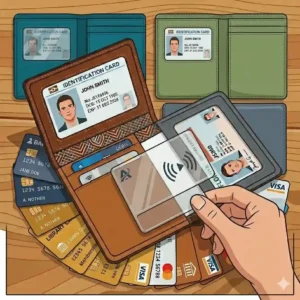
Minimalist vs. Traditional: A Detailed Cost & Usability Analysis
Moving from a traditional bifold to a minimalist id card wallet isn’t just an aesthetic shift; it alters your total cost of ownership and daily usability.
The Traditional Bifold Flaw:
Traditional leather bifolds rely entirely on tight leather pockets for card retention. Over two to three years of taking cards in and out, the leather permanently stretches. Once that happens, your cards are at risk of sliding out when the wallet is held upside down. This necessitates buying a new $50-$100 wallet every few years, resulting in a higher long-term cost.
The Minimalist Advantage:
Minimalist metal wallets utilize rigid chassis and replaceable elastic tension. Because the metal never stretches, the retention on the cards remains identical on day 1,000 as it was on day one. If the elastic fails, you spend $10 on a replacement band rather than $100 on a new wallet.
From a usability standpoint, traditional wallets force you to open them like a book to view your assets. Minimalist carriers rely on tactile memory—you quickly learn that your ID is the top card and your primary credit card is the bottom card, allowing you to deploy them by touch without even looking down.
Common Mistakes When Buying Minimalist Wallets
Even with the best gear, user error can ruin the experience. Here are the most common pitfalls I see buyers make:
-
The Costanza Complex: Buyers purchase a slim wallet and immediately try to force 15 cards, a wad of receipts, and a spare key inside it. This destroys the structural integrity of elastic and jams mechanical wallets. If you buy an id card wallet, you must commit to the minimalist lifestyle.
-
Ignoring Pocket Placement: Metal wallets belong in your front pocket. If you put a block of solid titanium in your back pocket and sit on a hard wooden chair, you will bruise your sciatica and potentially damage the furniture.
-
Forgetting About Embossed Cards: Many metal wallets claim to hold “up to 12 cards.” That calculation is based on perfectly flat, non-embossed ID and credit cards. If your bank still issues cards with raised plastic numbering, each of those takes up the space of 1.5 flat cards. Adjust your capacity expectations accordingly.
✨ Don’t Miss These Exclusive Deals!
🔍 Upgrade your everyday carry with these durable, efficient solutions. Click on any highlighted item to check current pricing and availability. Streamline your pockets today!
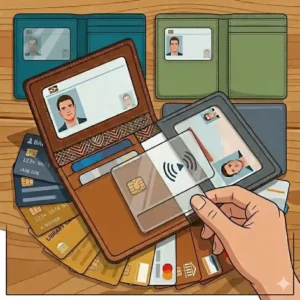
Conclusion: Your Pocket’s New Best Friend
Upgrading to a purpose-built id card wallet is one of the highest-leverage improvements you can make to your daily routine. It eliminates lower back pain, streamlines your check-out process, and forces a healthy decluttering of your personal effects.
Whether you opt for the mechanical brilliance of the Ekster Senate, the apocalyptic durability of the Ridge Wallet, or the ultra-lightweight freedom of the Thread Wallets Slim, the key is choosing a carrier that matches your specific daily environment. Stop carrying yesterday’s receipts and expired gift cards. Invest in a tool that respects your time, secures your data, and looks fantastic doing it.
FAQs
❓ What is the main purpose of an id card wallet?
✅ Its primary purpose is to securely hold your most vital everyday cards—like a driver’s license, primary credit card, and transit pass—while drastically reducing pocket bulk. It prioritizes rapid access and front-pocket carry over massive storage capacity…
❓ Can a minimalist wallet hold cash?
✅ Yes, but with limitations. Most metal models feature an external money clip or elastic cash strap designed to hold a few folded bills. If you carry large amounts of cash daily, a hybrid leather/clip model is much more efficient…
❓ Do metal wallets damage credit cards?
✅ High-quality models use smooth internal tracks or beveled edges to prevent scratching. However, dirt and grit trapped inside a metal chassis can act like sandpaper. Regularly wiping down your cards and blowing out the wallet’s interior prevents this issue…
❓ Are smart wallets worth the extra money?
✅ If you value quick access and often find yourself fumbling at checkouts, the push-button mechanism of a smart wallet is incredibly convenient. They also typically feature a uniform, professional look that fits well in corporate environments…
❓ How many cards should I actually carry?
✅ For the average user in 2026, 4 to 6 physical cards are optimal. This typically includes a photo ID, one credit card, one backup debit card, a health insurance card, and perhaps a transit or access badge…
Recommended for You
- 5 Best credit card protector Options for Total Security in 2026
- 5 Best kate spade coin purse Models for 2026: Expert Buying Guide
- 5 Best ID Holder Wallet Options for Minimalists in 2026 (Expert Tested)
Disclaimer: This article contains affiliate links. As an Amazon Associate, I earn from qualifying purchases. If you purchase products through these links, we may earn a small commission at no additional cost to you.
✨ Found this helpful? Share it with your friends! 💬🤗
[addtoany]
